By Alisha Pennington, Founder of Exette | June 2026 | 7 min read
Nearly half of all business owners in America are women. They generate $3.3 trillion in annual revenue and employ nearly 13 million people. And only 1% of them will ever exit their businesses.
That statistic gets cited a lot. What gets cited far less is why.
It is not valuation. It is not access to advisors. It is not even the complexity of the deal. The number one barrier women report when asked about exiting their business is identity. Specifically: who am I without this company I built?
That question does not have a financial answer. And until recently, it did not have a room either.
In June 2026, I created one.
The Conversation the Exit Industry Is Not Having
Exit planning as an industry is built around financials. Valuation multiples. EBITDA. Deal structure. Letter of intent. These things matter enormously. But they assume that the founder has already done a different kind of work — the internal work of separating her identity from her business — and most women have not.
Research on founder psychology has a name for what happens when that separation does not occur: identity fusion. It is the point at which the boundary between the founder and the business disappears. The business is not something she has. It is who she is. And exiting it does not feel like a transaction. It feels like self-erasure.
For women specifically, this is compounded by decades of sociocultural conditioning that ties self-worth to productivity and output. The female founder who is financially ready to sell is often years behind herself emotionally — not because she is weak, but because no one has ever given her a framework for what comes before the deal.
There is no exit plan because there is no plan at all. Most of these women think they cannot sell it. Or they think it is a pipe dream.
That was said to me by Alexis Allen, a Certified Exit Planning Advisor, in our debrief after Build to Exit at NY Tech Week 2026. It is the most honest summary of the female exit gap I have heard.

What Build to Exit Actually Was
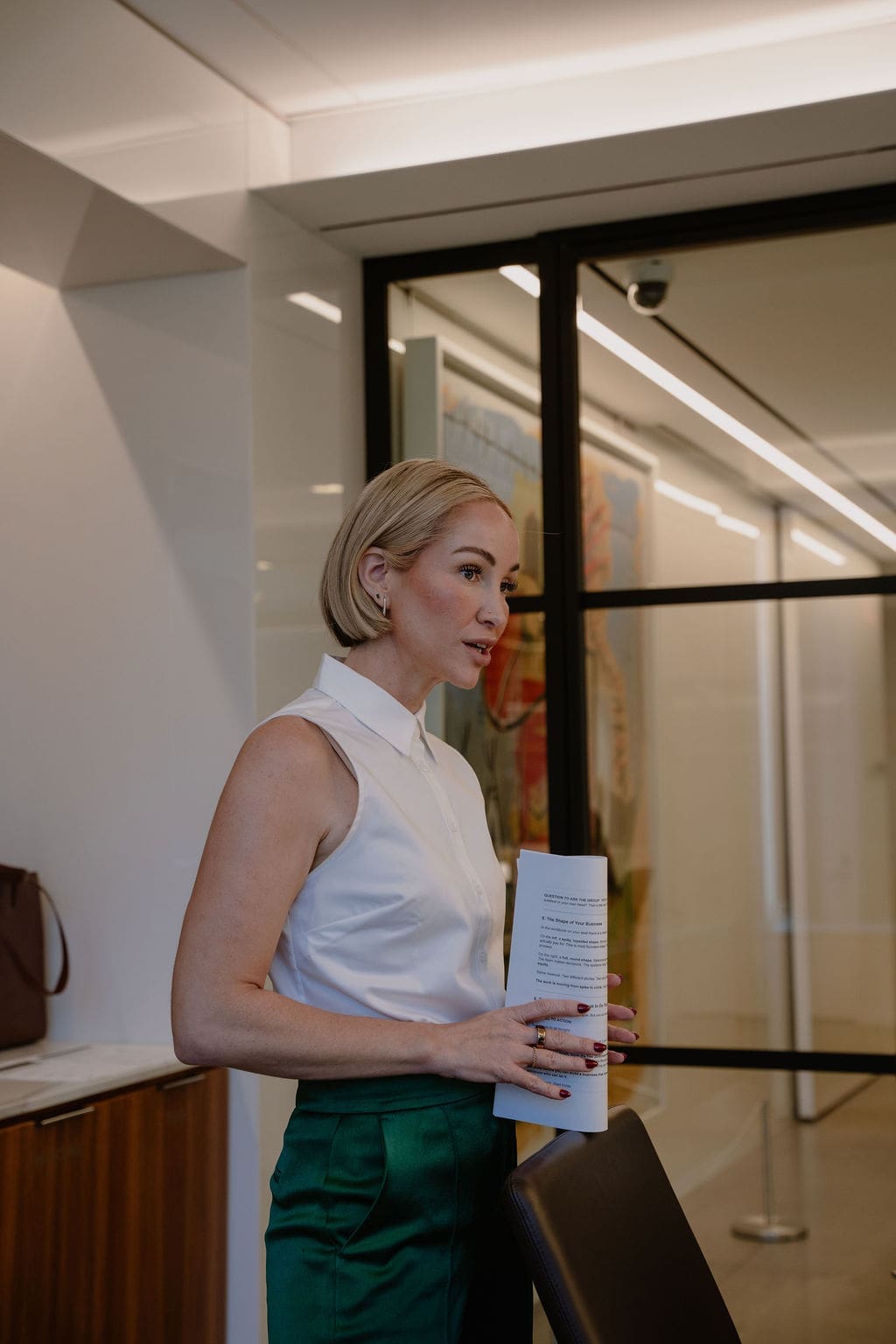
Build to Exit was a 90-minute hackathon hosted at NY Tech Week 2026 in New York City. It was not a panel. It was not a keynote. It was a working session.
Three facilitators. Three lanes. One room full of women founders who came because this conversation was not happening anywhere else.
The Identity and Psychosocial Work
I led the identity audit, which was a guided worksheet built around four documented psychological dimensions that determine whether a woman actually exits her business or keeps building past the point she should have stopped:
- Identity Fusion: the point at which the business becomes who you are rather than something you have.
- Entrepreneurial Role Incongruity: the tension between who you are as a founder and the cultural script that says founders are supposed to keep building, never stop, never sell.
- Sociocultural Conditioning: the productivity-as-worthiness pattern that tells women their value is their output — and that exiting means giving up.
- Psychological Disengagement Readiness: the internal work of becoming someone who can let go before the deal is done.
Attendees worked through seven questions designed to surface what had been unsaid. Not what they thought they should feel. What they actually felt.
The Financial Readiness Work
Alexis Allen, CEPA, of the Teixeira Loughran Group, led the financial readiness section. She opened with a simple exercise: every founder in the room wrote down what they thought their business was worth — independent of their own involvement.
Most of them undervalued it dramatically.
That gap between what a founder thinks her business is worth and what it is actually worth on the market is one of the most consistent patterns in exit planning for women entrepreneurs. It is not a math problem. It is a belief problem. And the financial conversation cannot be had productively until the identity work has begun.
The Operational Readiness Work
Adrienne Dolson, CEO of Level 11 Leaders, led the operational section using her Out of Office diagnostic framework. She walked the room through seven questions that reveal whether a business is a sellable asset or a job its founder cannot quit:
Could your business run for 60 days without you? Is your revenue tied to you or to the business? Could a buyer step in and operate this without you?
For most founders in the room, the honest answers were uncomfortable. That was the point.

What the Room Revealed
The ones who made it into the room came with specific questions and left with something they had not had before: a framework, a number, a name for what they had been feeling.
The co-hosts said it better than I could.
The right people were in the room and I was not disappointed with how many people showed up. I loved the engagement. I got a lot of value around the questions they asked. It is obvious this is not a conversation being had in these rooms with these kinds of women. Take us on tour.
— Adrienne Dolson, CEO, Level 11 Leaders
I had never done anything like that before. I do very one-to-one work, so I loved the balance of collaboration and workshop. It was very tangible and tactical, not just lecture. We did a good job of focusing on the main three dimensions. Better to have a smaller group who are actively engaged. I think they all walked away changed, with new ideas. It was a really good first event for the three of us to do together. I can see how it scales.
— Alexis Allen, CEPA, Teixeira Loughran Group

What This Tells Us About the Female Exit Gap
The most common thing I heard across the event was some version of: I did not know this existed. Not the event. The conversation.
Women founders have been building in isolation, scaling without a clear picture of what comes next, and exiting (when they do) without the infrastructure to do so on their own terms. The exit industry has spent years trying to solve this with better financial tools. Those tools matter. But they are built for a founder who has already answered the identity question.
Most women have not answered it because no one has ever asked.
That is the gap Exette was built for. And Build to Exit was the first public proof that the audience exists, the conversation is ready, and the format works.
Who Should Be Having This Conversation Next
If you are a woman founder who has ever thought about what it would look like to sell your business, even as a distant possibility, even as a thing you are not sure you deserve, this conversation is for you.
If you are a wealth manager, financial advisor, or exit planning professional who works with female founders, the research is clear: the number one barrier to your client’s exit is not in your financial model. It is in her identity. The firms that start addressing that now will serve this market better than anyone else.
If you are a fintech builder or investor looking at the female founder market, you are looking at $3.3 trillion in revenue and 14.5 million businesses — and almost none of the exit infrastructure has been built for them yet.
What Comes Next
Build to Exit is not a one-time event. It is the beginning of a curriculum.
Virtual versions of this conversation are coming. The format will evolve to include breakout sessions tailored to where each founder is in her journey. The gatekeepers (CEPAs, wealth management firms, women’s communities with the right audiences) are already in conversation.
The Exette Community is the place where this conversation continues between events. It is a private space for women founders who are thinking about what comes next: the financial picture, the operational readiness, and the identity work that has to happen before any of it is possible.
If you are ready to start that work, the community is where it begins.
The exit, made feminine. Join the Exette Community.
Are you a wealth management firm or CEPA looking to better serve female founder clients? Learn about Exette’s enterprise training at exette.co.
+ view the comments